eCYBERMISSION 2027: Check Eligibility Before You Build
Before your team starts testing, confirm that every student can participate, win, and advance. Then build a Mission Folder around dated evidence, a cost log, and disclosed AI use.
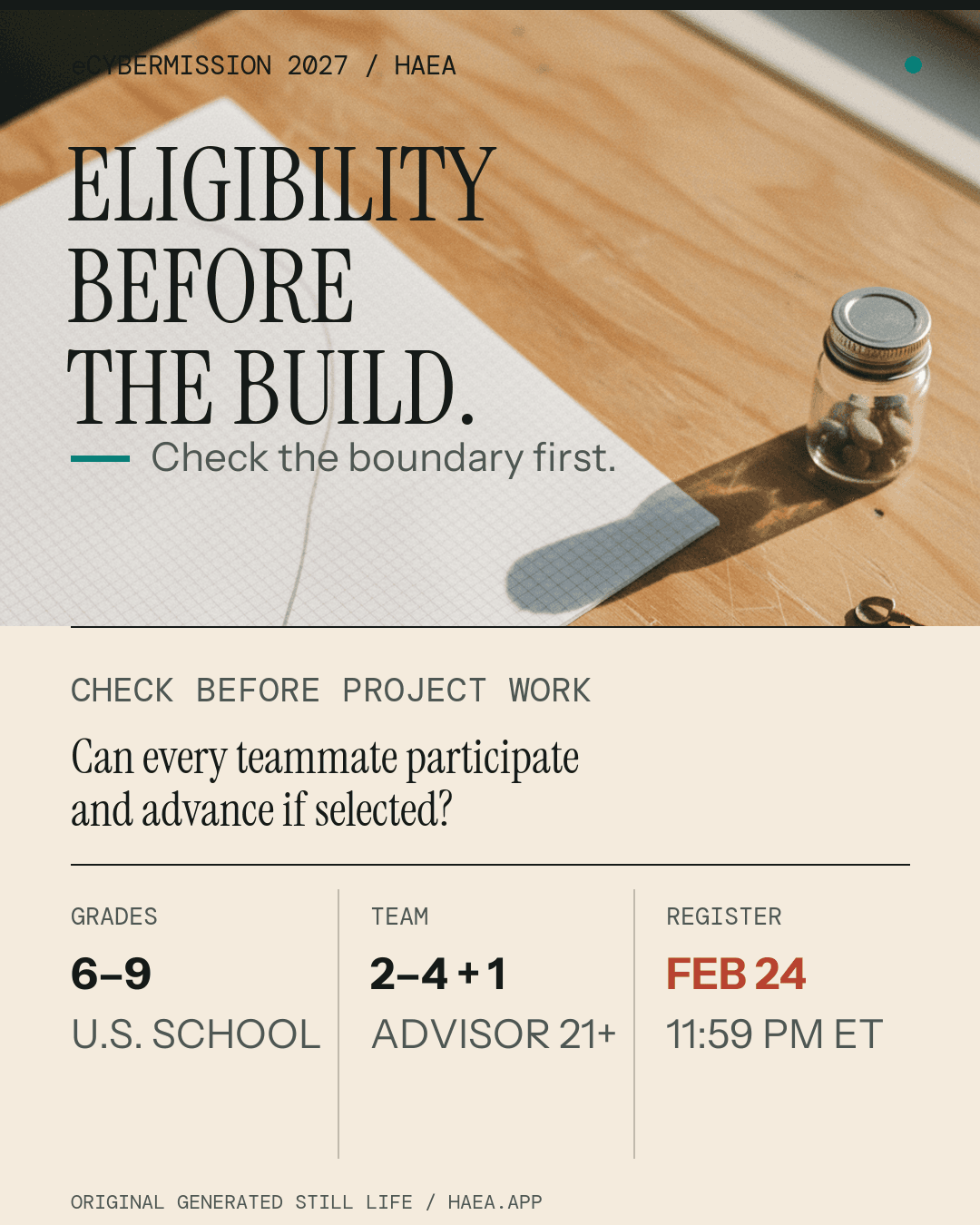
Before choosing a community problem, confirm that every student can participate, win, and advance. The current rules draw a firm U.S. eligibility boundary.
Run the eligibility check first
Students must be in grades 6 through 9 and enrolled in a U.S.-based public, private, or homeschool, or the overseas school category named in the September 2026 rules. A team has two to four students and one Team Advisor age 21 or older.
U.S. citizens and lawful permanent residents can participate and advance. Visa holders may participate but cannot win awards or enter Regional Judging. General Canadian schools are not included.
Decide this now: can every teammate participate, and can every teammate advance if selected?
The official program overview says entry is free. Advisors may guide, but students must do the project work. Parent or guardian permission is required for outside project contacts.
Put both deadlines on one page
Work for this cycle may not begin before April 1, 2026. All students and the Team Advisor must be registered on a complete team by February 24, 2027 at 11:59 PM ET.
The Mission Folder is due March 3, 2027 at 11:59 PM ET. It must be in English and may include up to 40 attachment pages, with each file no larger than 10 MB. Shared‑drive links are not allowed; public video links are the exception.
A physical model, website, app, or other prototype cannot exceed USD 250 in total value. Read the current competition rules before spending or uploading.
Keep evidence before polish
Keep a dated problem map, measurement sheet, prototype photos, change log, and cost ledger. These are HAEA preparation tools, not required templates. The official Scientific Inquiry rubric shows how judges look for clear variables, sufficient data and conclusions supported by the data.
One decision per record: what changed, what evidence supports it, and what the team will test next.
Treat AI as disclosed support
AI may help with topic exploration, background research, outlines, grammar, coding, calculations and visualization. Students must verify outputs and remain the primary authors, researchers and decision‑makers.
AI cannot supply the final question or hypothesis, the complete experiment or solution, substantial Mission Folder sections, the abstract, conclusions, invented citations or fabricated data. Teams using AI must keep records and include an AI Use Statement naming the tool, purpose and verification method.
Form an eligible team and start one shared evidence ledger. Recheck the official rules before registration, spending, outside contact, AI use, and submission.
Sources disclosed for this article
3 links · 3 primary/official- 2026-2027 eCYBERMISSION Competition Rulesdrive.google.comPRIMARY ↗
- eCYBERMISSION Program Overviewusaeop.comPRIMARY ↗
- Scientific Inquiry Mission Folder Rubricstatic.nsta.orgPRIMARY ↗
Disclosure means a clickable source is attached; it does not make every interpretation infallible.