ExploraVision 2027: Entry, Awards and AI Checklist
ExploraVision teams face two eligibility gates. Check who may enter, who may advance, the January 27 deadline, five submission parts and the flyer‑specific AI rule.
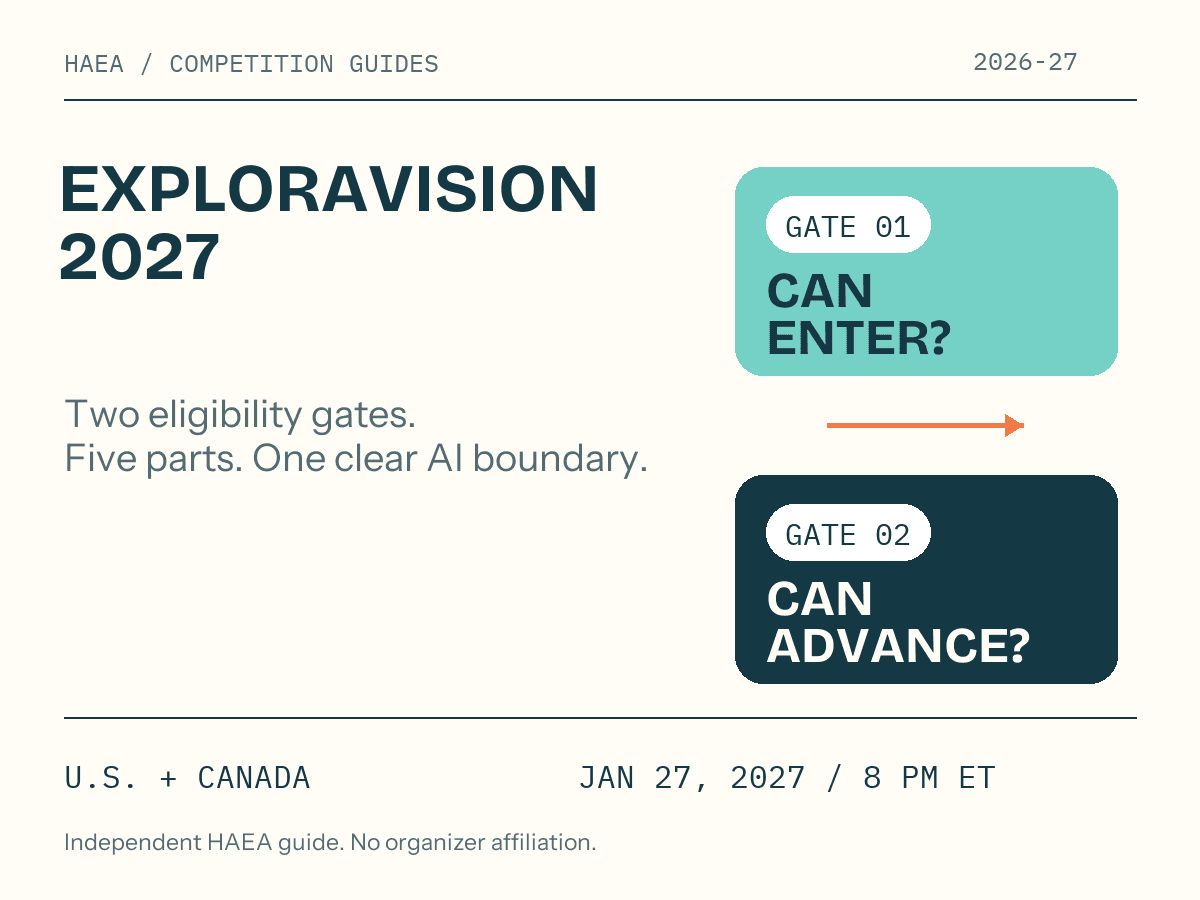
ExploraVision has two different eligibility questions. First, can your team submit? Second, can your team advance and receive awards? The current official pages do not use identical shorthand, so teams should check both before they commit months of work. Official Rules and Requirements
The coach must submit the 2026-27 entry by January 27, 2027, at 8:00 PM Eastern Time. Registration is open, and the official FAQ repeats the same deadline. There is no entry fee. Official ExploraVision FAQ

Start with the two eligibility gates
The Rules page says full‑time K-12 students may participate if they reside in the United States, Canada or a U.S. territory, or attend a Department of War Education Activity school abroad. Students must be no older than 21. The same page says that a team may advance as a regional or national winner only when every student is a U.S. or Canadian citizen. Official Rules and Requirements
The FAQ opens with narrower citizenship wording, then separately says permanent residents may participate but are not eligible for prizes. Read these pages together as a two‑gate warning, not as permission to guess about an individual case. A coach with a student whose status does not fit the published examples should confirm eligibility with the organizer before substantial work begins. Official ExploraVision FAQ
HAEA preparation check, not an extra contest rule: write two lines at the top of your team plan, one for entry eligibility and one for advancement eligibility. Do not replace either line with the word eligible until the coach has checked the official pages.
Teams have two to four students, and individual entries are not accepted. The oldest student determines the division: grades K-3, 4-6, 7-9 or 10-12. Students from different schools or states may form one team, but each student may submit only one project in the competition year. Official Rules and Requirements, Official ExploraVision FAQ
Give the coach a real operating role
Every team needs one coach who is at least 21 and knows at least one team member. The official examples include a teacher, counselor, youth‑organization leader or parent or guardian. The coach registers the team and submits the project online. Official Rules and Requirements
A mentor is optional. The FAQ describes the mentor as an additional resource person and says the coach and mentor cannot be the same person. This separation is useful: the coach owns registration and compliance, while a mentor can advise without quietly becoming the author of the work. Official ExploraVision FAQ
Before the team selects a technology, ask the coach to open the submission portal, confirm the division and record the deadline in Eastern Time. This is more useful than discovering an account or eligibility problem during the final upload.
Map the five submission parts
A complete standard entry has five parts: a title of no more than 50 characters, an abstract of no more than 150 words, a project description of no more than 11 pages, a bibliography and a one‑page Technology Launch Flyer. Grades K-3 and grades 4-6 have alternate official templates, so younger teams should use the format assigned to their division rather than copying the grade 7-12 structure. Official project format
For the standard format, the description is double spaced with one‑inch margins and a standard font from 12 through 18 points. Its labeled sections cover present technology, history, a future technology at least ten years ahead, required breakthroughs, the design process and positive and negative consequences. The design‑process section asks for three alternatives the team considered and why the selected feature was stronger. Official project format
The bibliography sits outside the 11-page description limit. The abstract also sits outside that limit, and the flyer is uploaded separately. Treating these as separate files or fields early will prevent the team from squeezing every requirement into one late document.
HAEA editorial guidance: this checklist explains the required containers. It does not supply a technology idea, a breakthrough, three alternatives or submission prose. Those choices and words belong to the students.
Use AI inside the published boundary
ExploraVision permits AI tools, including ChatGPT, for brainstorming and research, but says they should not be the team's only resource. Information found through an AI tool must be traced to and cited from the original source. The project‑format page also asks teams to include a link to the full text of any cited LLM conversation. Official project format
The same page treats unattributed AI‑generated content as academic dishonesty. A separate boundary applies to the Technology Launch Flyer: its visual representation of the prototype may not be generated or drawn with AI. That means a team can use AI in a disclosed research process and still violate the rules if it uses a generated prototype image in the flyer.
Build a simple AI‑use log with four columns: date, question, original source checked and where the use is cited. Save full conversation links only when the official policy calls for them, and review what those links reveal before submission. The official pages govern; this article is not a substitute for the current AI policy.
Plan backward from January 27
No physical prototype is required at entry. The FAQ says the flyer needs a visual representation, while a regional winner is later asked to construct a model that does not need to function. This distinction lets an entry team spend its early effort on research, design reasoning and evidence instead of building too soon. Official ExploraVision FAQ
Use a six‑week preparation board with one owner for each of the five submission parts. A hypothetical schedule of two 45-minute meetings each week for six weeks gives 2 * 45 * 6 = 540 minutes, or 540 / 60 = 9 hours of shared meeting time. These are planning inputs, not an ExploraVision requirement and not an estimate of how long a strong entry takes.
Suggested preparation sequence:
- Week one: confirm both eligibility gates, the division, coach and portal access.
- Weeks two and three: research the present technology and its history using original sources.
- Week four: compare three design alternatives and identify the breakthroughs that would be needed.
- Week five: draft the abstract, description, bibliography and flyer with the AI‑use log beside them.
- Week six: run page, citation, flyer and file checks, then submit before the final day.
Set an internal deadline at least several days before January 27. Registration is not the same as a completed submission; the coach should preserve the organizer's confirmation after the files are uploaded.
Decide whether this competition fits
ExploraVision is a research‑and‑design competition, not a quick prototype contest. A team should be willing to explain how a present technology works, imagine a version at least ten years ahead, identify scientific breakthroughs, compare alternatives and discuss both benefits and harms. Official project format
The 2026-27 program is in its 35th year. NSTA says the entry phase gives submitting teams a certificate, a gift and judge feedback, while regional and national stages add further awards. Awards should not replace the fit check: the best reason to enter is that the team wants to do the research and design work the format requires. NSTA 2026-27 announcement
Your next step: take the Rules, FAQ and Project Format pages to a potential coach. Confirm both eligibility gates, then decide whether two to four students can own the research and writing through the January deadline. Open the official Rules and Requirements
Official sources were checked October 8, 2026. Requirements can change; use the organizer's current pages before submitting.
Sources disclosed for this article
4 links · 4 primary/official- ExploraVision Science Competition Project Format and Requirementsexploravision.orgPRIMARY ↗
- Toshiba and NSTA Kick Off the 35th Annual ExploraVision Competitionnsta.orgPRIMARY ↗
- Toshiba NSTA ExploraVision Frequently Asked Questionsexploravision.orgPRIMARY ↗
- Toshiba NSTA ExploraVision Rules and Requirementsexploravision.orgPRIMARY ↗
Disclosure means a clickable source is attached; it does not make every interpretation infallible.