NASA TechRise 2026-27: Your Proposal Checklist
NASA TechRise starts with a student‑written proposal. Check your school's eligibility, the November 2 deadline, PDF requirements and AI restrictions before your team commits.
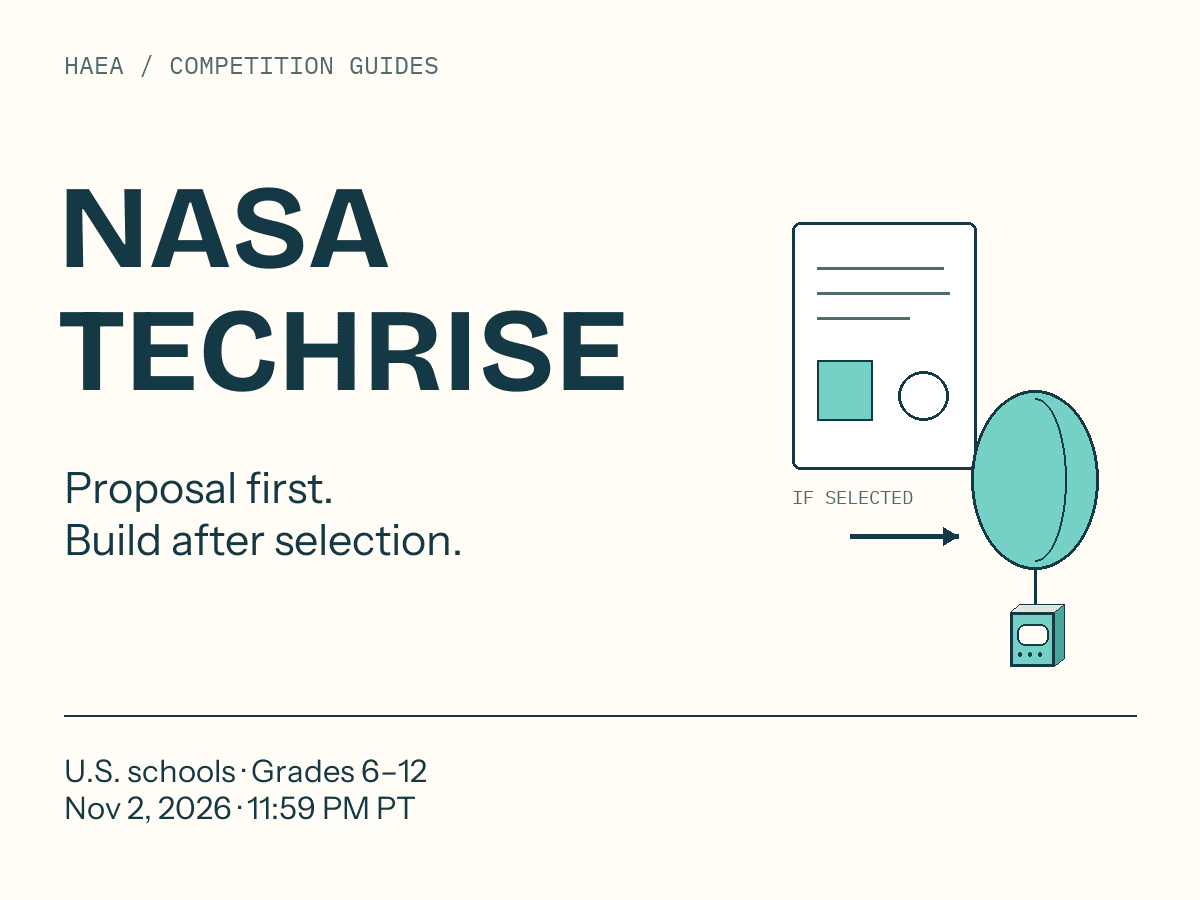
You do not need a working payload to enter NASA TechRise. The first submission is an experiment proposal; selected teams receive support to develop it for a NASA‑sponsored high‑altitude balloon flight. NASA's TechRise overview
The 2026-27 entry deadline is November 2, 2026, at 11:59 PM Pacific Time (PT). The organizer publishes that exact time, so do not treat it as a local midnight deadline. Official resource and pacing guide
Check your school before developing a proposal
Teams need at least four students in grades 6-12 who attend the same eligible U.S. public, private or charter school. There is no maximum team size. A teacher or school employee serves as team lead and submits the entry. Organizer's eligibility and entry steps
The authorized lead must be a legal U.S. resident; the rules describe the age condition as 18 or older or having reached the legal age of majority in the lead’s state. This is not an individual, student‑only signup. Official rules
For readers in Canada, school location matters: a Canadian school team cannot enter simply because submission is online. The rules define the eligible U.S. area as the 50 states, Washington, D.C., and specified U.S. territories; physically non‑U.S. schools are excluded. Do not substitute a student's nationality for the school‑location check. Official rules, eligibility section
The school also needs acceptable liability insurance, with proof required before a prize is awarded. Standalone homeschools and youth groups are excluded, while some school‑affiliated independent‑study programs can qualify. Federal schools are excluded; the rules separately address eligible tribally controlled schools. Official rules
HAEA preparation check, not an additional contest rule: ask the adult lead to confirm the school's eligibility, insurance and submission access before the students spend October on a proposal.
Know what you are actually submitting
The entry is a PDF of no more than 20 MB. Its student‑written proposal narrative may be no longer than three pages, including in‑text citations, using 11-point Times New Roman, single spacing and one‑inch margins. Official proposal example and template
Include an experiment name and the template's what, how and why sections, with a diagram of the proposed components. Do not include school names, student names, photographs of people or other identifying information. Links cannot add extra proposal material beyond the page limit. Official proposal guidance
You do not need to build the experiment to enter. The proposal comes first; the build follows selection. Organizer's design instructions
Keep the idea and writing student‑owned
This year's rules prohibit AI‑generated experiment ideas and substantive entry content. Limited grammar, spelling and similar assistance may be acceptable at the sponsor's discretion; that is not blanket permission to use AI. The proposal guidance requires students to write the narrative. Official rules, proposal guidance
HAEA editorial guidance: use this article to navigate the requirements, not as text to copy into an entry. Students must develop their own experiment ideas and substantive proposal content; teacher coordination does not change that requirement.
Read the flight constraints before making a shopping list
The design guide specifies a 4 x 4 x 8-inch flight box and a maximum total mass of 1 kg, including the box. The balloon supplies power; batteries and radiofrequency transmissions, including Wi‑Fi and Bluetooth, are not allowed. 2026-27 high‑altitude balloon design guidelines
Purchased components should fit within the $1,500 funding amount. A budget is not required for judging, but designs needing additional funding score lower. These are selected checks, not the complete technical specification or an instruction to buy parts before selection. Official design guidelines
HAEA preparation guidance: read the full design guide together before students settle on their own question. Have each member explain how the diagram connects that question to a measurement and to the data the team would examine. If that connection is unclear, another planning session is more useful than another polished paragraph.
Make a realistic October work plan
The official educator guide supplies resources for learning about balloons, brainstorming and planning components. Use those organizer‑provided materials for experiment‑development work. Resource and pacing guide
Our suggested sequence is preparation guidance, not another contest rule:
- First meeting: confirm the school, four‑student minimum, adult lead and access to the submission account.
- Next meetings: have students use the official resources, develop their own question and check the flight constraints.
- Draft review: compare the explanation and diagram. Can every member explain what is being measured and why?
- Final week: export the PDF, check formatting and anonymity, and leave time for the teacher to submit.
For a hypothetical meeting budget, two 45-minute meetings a week over four weeks gives 2 * 45 * 4 = 360 minutes, or 360 / 60 = 6 hours of scheduled team time. These are invented planning inputs, not a TechRise requirement or an estimate of the time needed to finish. Research, student writing and teacher administration need their own allowances.
Keep a shared checklist with an owner for each check. Set an internal deadline earlier than November 2 so the final day is a buffer, not the team's first upload attempt. The adult lead should verify the actual submission confirmation rather than assuming that registration alone completes the entry.
Understand the commitment after selection
The challenge offers prizes for up to 60 schools. Selected teams receive $1,500 for experiment development, a starter kit with a flight box, technical support and a flight‑test opportunity. This is project funding and support, not a personal scholarship. Official rules, NASA's program overview
NASA describes a January‑to‑May 2027 build period and summer 2027 flights. The rules also require school permission, parental consent where required, insurance and signed releases before the prize/build process. A teacher should review that commitment with the school before entering. NASA's program overview, official rules
No purchase or payment is required to enter or win. The entry must be original and must not have been submitted to another contest. Official 2026-27 rules
Your next step: take the official challenge page to a teacher and check whether your school can support a team. Then let the students develop the experiment themselves. Open the official NASA TechRise challenge
Official sources were checked October 1, 2026. Requirements can change; use the current organizer materials before submitting.
Sources disclosed for this article
6 links · 6 primary/official- NASA TechRise 2026-27 educator resource and pacing guidefestorage.blob.core.windows.netPRIMARY ↗
- NASA TechRise 2026-27 high-altitude balloon design guidelinesfestorage.blob.core.windows.netPRIMARY ↗
- NASA TechRise 2026-27 proposal example and templatefestorage.blob.core.windows.netPRIMARY ↗
- NASA TechRise Student Challenge 2026-27futureengineers.orgPRIMARY ↗
- NASA TechRise Student Challenge 2026-27 official rulesfestorage.blob.core.windows.netPRIMARY ↗
- NASA TechRise Student Challenge overviewnasa.govPRIMARY ↗
Disclosure means a clickable source is attached; it does not make every interpretation infallible.